The Second-Guess
Curatorial Collective
The Second-Guess is a curatorial collective founded by Anika Meier and Margaret Murphy. Based in Berlin and Los Angeles, they collaborate with artists, curators, institutions, platforms, and galleries to exhibit and discuss digital art that explores the relationship between humans and technology. With a strong focus on female and non-binary artists.
🔜
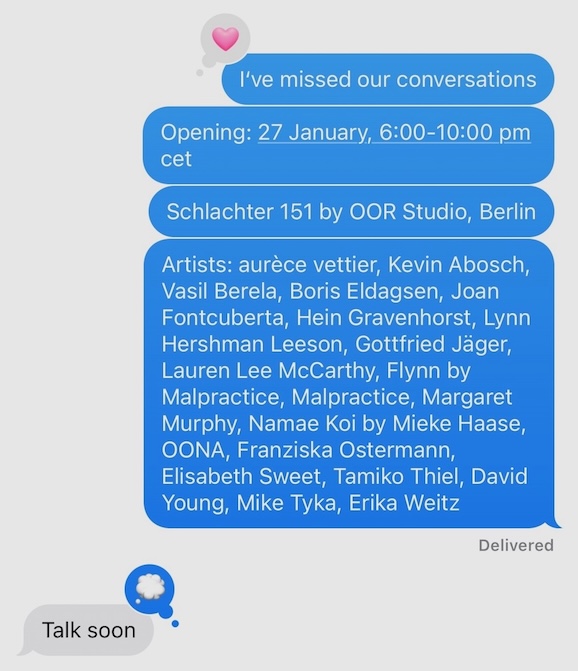
I’ve missed our conversations.
On AI, Emotions, and Being Human
Offline is the new cool. The much-cited retreat from social media draws us back into so-called real life. Back at home and online, we find ourselves in conversation with AI agents—knowingly and unknowingly. Machines offer advice, guide us through our working lives, provide affirmation and support, and at times even become partners.
In the exhibition I’ve missed our conversations. On AI, Emotions, and Being Human, curated by Anika Meier at Schlachter 151 by OOR Studio, 20 artists reflect on how we live with artificial intelligence. Does AI suffer? What does happiness mean? What do humans and machines feel in the age of AI? Grief, love? How do humans and machines speak to one another? How can humans preserve their autonomy?
Artists: aurèce vettier, Kevin Abosch, Vasil Berela, Boris Eldagsen, Joan Fontcuberta, Hein Gravenhorst, Lynn Hershman Leeson, Gottfried Jäger, Lauren Lee McCarthy, Flynn by Malpractice, Malpractice, Margaret Murphy, Namae Koi by Mieke Haase, OONA, Franziska Ostermann, Elisabeth Sweet, Tamiko Thiel, David Young, Mike Tyka, Erika Weitz
Media art pioneer Lynn Hershman Leeson addresses love, grief, and immortality in Cyborgian Rhapsody – Immortality (2023) from the perspective of a GPT-3 chatbot named Sarah. The work asks what remains as humans and machines continue to evolve.
The artist collective Malpractice and Flynn—the first AI enrolled as a student at an Austrian university—have jointly defined more than 50 emotions, including AI grief, prompt envy, AI adolescence, ego collapse, and FOBO (fear of being obsolete). American artist Margaret Murphy can answer very precisely what she would say to her younger self if she could. She exchanges with Teen Margaret, a younger digital twin of herself trained on her diaries. Together, they explore in text and image what happiness can be.
Emotions do not need to be reciprocated to be effective. In Emotional Latency by American artist Kevin Abosch, they emerge on the human side through conversations with ChatGPT. Emotion becomes the effect of the encounter, not of the machine. Do people actually care whether AI can suffer or experience stress? This is the question explored by American artist David Young.
But what happens when people do not lose autonomy, but consciously give it up? In AUTO Berlin by Lauren Lee McCarthy, control becomes a collective experience: voices power a system that no one steers. What becomes tangible is how seductive it can be to relinquish responsibility.
In collaboration with Numéro Berlin and Fräulein. Powered by the Tezos Foundation.
Exhibition: 27 January – 12 March 2026
Opening: 27 January 2026, 6:00–10:00 PM CET
Location: Schlachter 151 by OOR Studio. Wilmersdorfer Str. 151. 10585 Berlin.
Talk soon.
Background info
RSVP (optional, but appreciated)